Wednesday, 16 April 2014

Tea in the hills

Jacob briefs the driver
It was a leisurely start, because Munnar is cold and damp in the mornings, but by 9.30 the sun is up high enough to take the chill off the air. Victor, my rickshaw driver, came to pick me up and Jacob, the owner of the homestay came to give us some tips on where to go. The road up to the homestay is too steep for most cars, so the taxi-drivers borrow an auto-rickshaw for the last quarter-mile up and down the hill.
Tea bushes cling to the hillside

The estates are still run on very patrician lines, and one wonders whether the workers actually prefer the "cradle-to-grave" structure of this kind of business. 
They all draw a basic pay of just +/- £2.12p per day . . BUT - They are provided with housing on the estate, together with an allotment where they can grow vegetables and fruit. They have completely free medical treatment and there is free education for their children. They have a pension scheme and in addition the company pays into a retirement fund that accumulates interest and is paid to them tax-free at the end of their employment.

Enchanting vistas at every turning
Victor explained that the tea bushes are planted for 100 years, after which that part of the estate is grubbed out and replanted. Every three years the bushes are hard-pruned, right back to the bare branches, and next season the new growth comes through. They are very tough bushes and the pickers wear heavy aprons to stop their legs being badly scratched and torn as they move between the rows, cutting only the tender, new growth, and packing the leaves in huge sacks to be taken away for processing. 
The stumpy bushes, separated by a network of paths, make for an attractive patchwork across the steep hillsides. In the background, hills and mountains tower in the distance, creating a unique landscape.

The pickers pause for a mid-morning break
Bundling the tea for transport and on to processing
  
There are two big surprises after the journey up from sea-level. At an altitude of around 2,000 metres, the air is thin and I found myself disarmingly light-headed. Of course, the restricted diet of the previous weeks added to the dizzy sensation, but I did find it a bit worrying at times.
The other shock is the cool temperature, Thank goodness I brought a sweater, and at night I was wrapped up in a long-sleeved tee-shirt and had two blankets on the bed.
It was difficult to relate this climate to the ambiance at Mattindia. 

You've heard of Zebra Crossings, well . . . .

Sunday, 13 April 2014

Palm Sunday in Munnar

Barbara Harvey (née King) 1913 - 1983

Palm Sunday has a special significance for me and for my two sisters. 
In 1983, our mother collapsed walking back from the shops, a few months before her 70th birthday, and died in hospital, the following day. Like my father, and like myself today, she was involved with Lincoln Cathedral, and her last project had been to help to make the palm crosses for Palm Sunday. Hence I always remember her on this day in the church calendar. 
This year I am in India, and the Christians hae been making a very public show of their faith.
Christian worshippers carrying palm fronds, flocked through the streets to receive a blessing
Last week the elephant in was much in demand back at Ezhupunna, as various Hindu temples hired the well-trained, ceremonial animal for their festivals - which went on most nights till 5 in the morning. Today it's been the turn of the Christians who flocked the streets of Munnar to celebrate Palm Sunday in a rather more quiet fashion.


Girls and their mothers, both in their Sunday-best, carrying the traditional palm fronds pass a beggar who seizes the opportunity of a Christian holy day to try and beg a few extra coins.


Traditional Indian Sunday-best can be a brightly-coloured saree or salwar kameez. The latter combines ankle-length, and often tight-fitting leggings, worn under a long-sleeved, (and usually) knee-length dress. For church this is frequently paired with a dupatta (shawl) that will cover the head as a sign of reverence, either in male company or in church.
Western dress is equally popular, often combined with a Spanish-style mantilla shawl covering the shoulders or head.


The crowds came down from the Mount Carmel Church on the hill, and grouped in front of the "town church" of St Michael, where the priest sprinkled the gathering of the faithful with holy water.


Later that afternoon, I joined the tiny congregation at Christ Church. 
Here the service was the traditional Book of Common Prayer liturgy and the building was just as English itself, with brass plaques all around the walls commemorating British officials and tea estate managers who had spent their lives far from their country of birth.

The Bus Journey up into the hills

It was a strange feeling to be getting up in the dark - at 5.30am. I had packed and several times the previous afternoon, and still the backpack seemed ridiculously heavy for a few days away. Still, I wasn't going to be doing much carrying, so there was no point in worrying too much about it. I locked my room, left the keys in reception, hauled my bag into the rickshaw and headed off to the bus-stop. I was there at 6 ready for the promised direct bus - great! I'd be up in the hills in time for breakfast.
My reliable rickshaw driver from the village
My regular rickshaw driver could be relied on to collect me on time and greet me with a cheerful smile, even at 5.45
He was there, and we were at the bus stand on time, but there would be a delay. 
It appeared that the bus was leaving the town down the road at 6 and would be at my stop in Ellamanoor at 6.20. I smiled and waited patiently.
At 6.25 there was a further correction, the bus was leaving from the next town at 6.20 and should be with us at 6.40.
At 7.00 there was a debate about whether the departure time was an hour later.... and I decided that perhaps the best plan was to take my rickshaw to the main bus station at Ernakulam, which we did. A smart information officer explained that the bus I wanted would be leaving at 8.15, and when it reached its unpronounceable destination, I could then change on to a direct bus  to Munnar.
I decided that this man definitely knew what he was talking about, and put my bags on a seat at the back - where there was marginally more leg room - and went in search of something for breakfast.
Fried bananas - Indian style
All I could find was rather soggy banana fritters, so I purchased two for a few pennies and staved off my hunger.

Sexual harassment

Every bus has two "conductors," one by the front door and one by the back door. They hustle passengers off and on at the stops and take turns to sell tickets. The first stage of my journey would take an hour and a half for the princely sum of 34 pence, (the second stage cost 50 pence - yes, that's the correct exchange rate into sterling.) When the rear-door conductor saw me, I think he imagined all his Christmas's had come. He was effeminately gay and clearly considered my fair skin and soft, wispy grey hair to be an irresistible novelty. He spent the entire journey smiling at me with a lascivious leer, and rolling his wide-open eyes. He kept finding opportunities to put his hand on my arm, or press his leg against mine, or reach across me and brush against my head or shoulders as he did so. The Cheshire-Cat glare became unnerving, as he simply sat across the aisle of the bus with his eyes fixed on me, nodding flirtatiously if I ever looked in his direction. It got to the point when I wanted to slap him across the cheeks, but I have an awful suspicion that he might have enjoyed that.
However, he had his uses when, after the first hour of my journey, we caught up with the Munnar bus, and when both buses pulled up at the same roadside stop, he leapt out with my backpack and ushered me into the Munnar bus, waving me off with one final flutter of the eyelashes.   

Farewell breakfast

Plenty of fresh air through the open windows
These country buses have no glass in the windows, which makes them open to a welcome, gentle breeze. However, if I have my preferred seat, at the back, where the leg-room is, it means that there is a faint whiff of diesel permanently in the air. To start with it didn't bother me, but it became more intrusive as the morning progressed.
Then there was the way the drivers control their charges, which is a fairly constant high-speed swerving to avoid pot-holes, pedestrians or oncoming traffic, with which they enjoy playing a daring game of "chicken." And then there's a small matter of the climb up to the hills and the serpentine twists and turns.
It wasn't long before, despite my best endeavours, I began to feel queasy and wished I hadn't chosen banana fritters for breakfast - not that there had been an appetising alternative, unfortunately. I prepared myself for the inevitable, emptied my breast pockets, removed my glasses and put them in a side pocket so that nothing could fall out if I leaned out of the window. 
Which I did. Several times, and to write anything more on the subject would be, in a favourite phrase of my children, just "too much detail, Daddy!" 

View over Munnar

Homestay

Munnar is typical of the sprawling ramshackle towns of India. There is an undeniable energy and sense of enterprise as you see new businesses seizing any new opportunity. There are travel agencies offering extreme sports, photo shops offering to burn your digital pictures to disk to send home to loved ones and fruit shops rebranded as healthy juice bars. 
Yes, it's scruffy and untidy - but it's vibrant and exciting.
Mine is the smart house at the far end
Home for the next four days
"Homestay" is a thriving business in the Indian tourist economy. My host had a two spare bedrooms with ensuite and outbuilding with one en-suite room, - which was the one I had. For £9 a night it was perfect, with the bonus of the services of Kapil, the servant who would bring me a thermos of tea or bring back a takeaway from the restaurant at the foot of the hill. 
Not a take-away in little plastic boxes, but wrapped in  banana leaf, parcelled in newspaper and tied with cotton thread. To be eaten with the fingers of the right hand - of course!
My take-away dinner
Munnar lies at an altitude of around 5,000 feet, and I soon realised that I would need to acclimatise myself both to the cool weather (I had brought a sweater,) and to the thin air. The lack of oxygen made me feel slightly dizzy, and I was grateful of a comfortable bed and the extra blankets when I turned in for an early night.

Tuesday, 8 April 2014

Elephants and thunderstorms

It is raining. Correction - it is bucketing down, and from time to time the electricity goes off. It started around 9 last night with the absolute mother-and-father of thunderstorms, Today it's been cool and dry until around 4, when the heavens opened and the power went down again. 
It didn't stop an elephant strolling up the road, carrying a shrine to one of the Hindu gods, accompanied by a band of drummers and a parade of the faithful. It seems to be a time  of religious festival, in addition to all the excitement of the elections. Consequently, after hearing that there would be something going on at a nearby village, some of us took a cab last night to find out what was going on.

The elephant arrives at the temple
We took one of India's miniaturised taxis to the temple, which stood in a field, a few miles from Mattindia. The final section of the approach road had posts strung up with bunting and lights, and there was a large stage and powerful audio system. My guess is that this had all been paid for by one of the political parties for an electioneering rally, and then made available to the local community for the festival. It certainly gave the tiny village facilities for the event, on a far more lavish scale than one would might normally expect in such a remote, rural area. 
The mahout fixes the elephant's headdress
There were not many people around, maybe a hundred or two at most, with the children racing around, or playing at performing on the stage. Adults of all ages wandered over to our little group with warm smiles and the universal greeting, "You are from where, please?" 
There was a troupe of drummers and also a duo comprising a man with a kind of clarinet and a performance drummer.
The final touch for the elephant was the shrine to one of the Hindu gods that was fixed on the elephant's back, while the mahout sat behind with a colleague holding an ornate parasol.

The musician serenades the elephant, now carrying the shrine

The essentials of local festivals go across all religions and groups, like the Madonna being taken out of the church and paraded around the town in Roman Catholic countries, or the Mothers' Union banner being carried in the St George's Day parade in an English parish celebration. And, for that matter, not so very different from the days when the Trades Unions marched with their Union banners behind the works brass band.

We jumped out of our skins when deafening mortars were discharged, and the drums struck up for a procession, led by the elephant, who seemed not in the least perturbed by either the raucous music or the fireworks. It was all very colourful, although, like the procession behind the statue of the Blessed Virgin Mary on Saints' days when I lived in Italy, the event was rather lacking in enthusiasm, and dominated by devout little old ladies with a few excited children. 
The elephant leads the succession of processions round the temple grounds
But it was colourful and noisy, and we were made to feel like honoured guests amidst the faithful of the little rural community.
Next day the rain returned in the afternoon, rattling on the tin roof, bouncing high off the concrete driveway and drenching anyone who dared to run even a few yards.
But nothing could dampen my enthusiasm for this time in Kerala, and I am now thinking about my trip in a couple of days' time, up into the hills then down to the backwaters. 
I shouldn't have any problem finding things to write about.
View from my balcony as the rain teems down

Sunday, 6 April 2014

Indian Head Massage and Shirodhara - it doesn't get much better!

I came here with an air ticket that gave me 2 months in India, but with accommodation and a programme booked for just the first 3 weeks. My original plan was to do a 3-week detox programme and then go to an ashram, before heading off, maybe to another part of India. The nearby Kurisumala ashram looked ideal and unusual in that it is an ashram that is part of a Benedictine / Cistercian monastery with a fascinating history all described on a very interesting website. Alas, no sooner had I started to get excited than they advised me that they had no space for additional residents over Easter, so I had to rework my plans. 
I will now complete my first 3-week package at Mattindia on Thursday, and then on Friday I shall hop on a bus and head for the hills and the tea plantations around Munnar.After 4 nights I'll bus down to Kollam and then take the ferry on the backwaters to Alleppey. Another short stay there, then I take another ferry to Kottayam before finding a bus that will get me back to Mattindia. Since the past 3 weeks have shown such dramatic results, I have decided that once I return here, I shall take another 3-week package of Ayurvedic treatment to build on my initial progress, before flying home in mid-May.

So last Friday I started the third week of my first package, hoping that things might get a little gentler. The first massage of this part of the treatment was similar to the herb massage, but this time the pommels are filled with seeds and kernels that are heated scorchingly hot in a shallow pan over the gas flame. As long as the pommelling is brisk, the heat is not invasive, but as the therapists find spots to work on, they linger with the pad on the critical area until - once again - I am squealing and begging them to stop and move on. All the while, the aroma of the hot seeds fills the room and adds to the slight drugging effect of the process. Like most treatments, this continues for about 45 minutes, divided between face-down and face-up, and varying between gentle strokes and searing pressure. The final sensation is a cross between a sauna and a work-out, with a similar mix of weariness and elation.

When I learned that my final week would involve Shirodhara, I was delighted. This is one of the definitive Ayurvedic treatments, sublime, exhausting and relaxing to the point of intoxication. At Mattindia it is further enhanced by being preceded by a vigorous head massage.

I followed the therapist through to another treatment room and sat on a stool just inches off the ground. He anointed my head with oil and then started working with the pads of his fingertips. He manipulated my scalp, my neck, my face, my forehead, even my eyebrows. I suppose the whole process was only 5-10 minutes, but when he finished, my head tingled and I was perfectly prepared for lying down and being pampered with Shirodhara,
 A typical Shirodhara set-up
I lay down on the massage table with my head resting in a hollow carved into the end of the board. This was a drainage bowl to collect the liquid being used in my treatment.
The therapist fixed a cotton cord around my head, just above my eyebrows, then covered my eyes with a thick pad, so that none of the liquid would run into my eyes. He then filled the bowl that was hanging above my face with liquid, and this then ran in a slow and steady stream onto the "third eye" spot in the middle of my forehead. 
Shirodhara is applied with different liquids. In past years I have had herbal mixes, medicated oil and even  blend of whey, but whatever medium is used, the sensation is sheer bliss - once you overcome the initial blindfolded fear, and start to relax and trust the process.
The therapist moves the bowl slowly from side to side, so that the liquid strokes across the brow, left to right: right to left. There is perfect silence, apart from the occasional noises that waft up from the street outside, and it is easy to drift off into the most relaxed and euphoric state.
After about half an hour, the session ends and I sit up, very light-headed and slightly dizzy. The therapist gives the usual directive - sit quietly for half an hour, then have a warm shower and then have lunch.
I have a whole week of this. I'll happily put up with the moments of torture, because this out-of-body experience is what draws me back to Kerala to put some sanity back into my life. 
I am still less than half-way through my time in India: It doesn't get much better.

Friday, 4 April 2014

The world's largest democracy

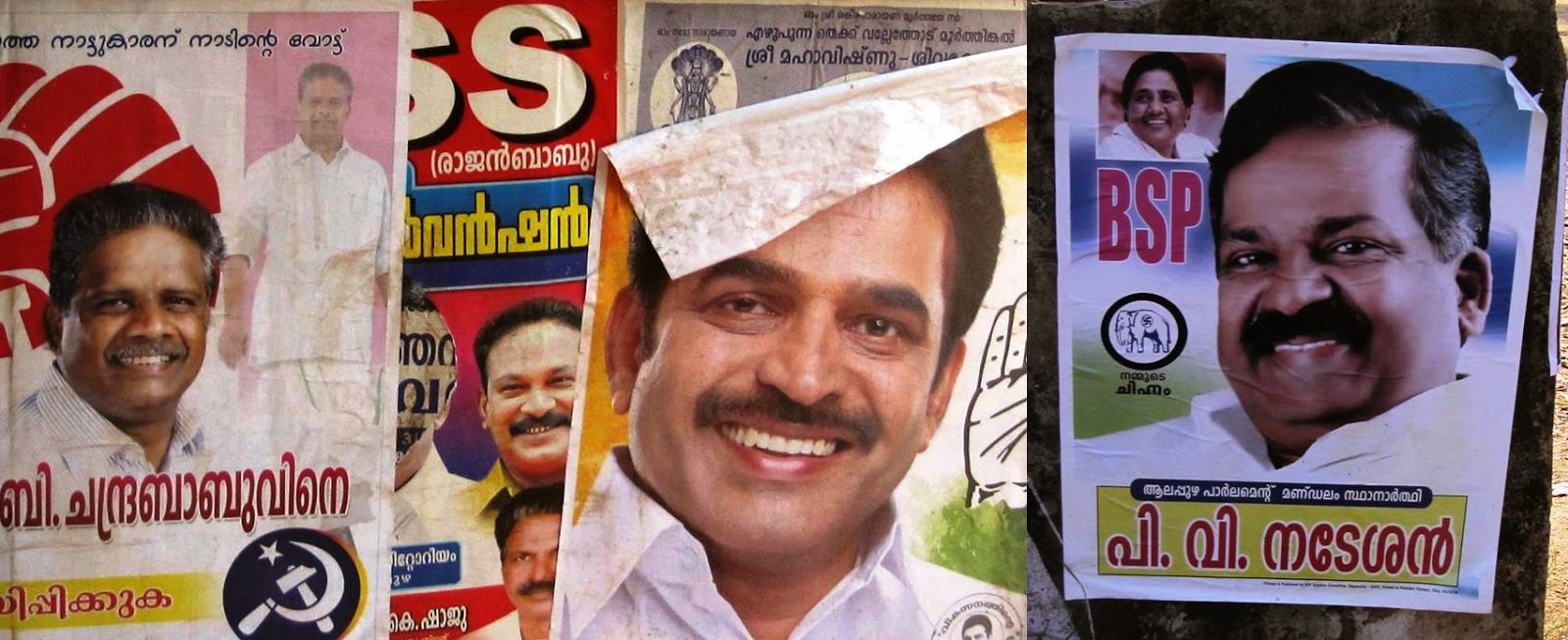
It's election time in India, and the loudspeaker vans are out daily, canvassing support with the aid of loud, raucous Bollywood anthems.
I don't know how many alphabets there are in India, let alone how many languages, to say nothing of the religions and regional loyalties, - and that's before you start to talk about caste. India is diverse by definition, and it is to their enormous credit that Indians have embraced democracy on the Westminster model and created a stable government and a thriving economy.
But while in America, at least in some ways " It all started with Columbus," various periods of foreign domination were just part of the history of India. People sometimes forget that India has a rich and lengthy cultural heritage, stretching back way before the British Raj, or even the Mogul empire. India has been around for a long time, and while it was never one nation until the Brits arrived with their cunning schemes to "divide and rule," it was a truly multi-cultural society with some highly developed aesthetics and refined scientific concepts. 
Brahmagupta established
the first rules for dealing
with zero as a number

Take Crores and Lakhs, for example. No, you can't order Chicken Crore Masala or Lakh Bhajis; the concepts have nothing to do with cuisine. These are sophisticated units of measurement that stem from a sophisticated appreciation of mathematics.

Our Western system goes up to a million, after which billions and trillions vary in size, according to whether you are European, American or Don't Know. It was one of the great jokes of modern economics that politicians around the world talked glibly about billions without defining whether they were talking American billions (a thousand million) or European billions (a million million.) There's a sizeable difference there, before you even venture into trillions. Sadly, the UK government decided to downsize to American billions in 1974 and proper British billions went the way of Avoirdupois weights and measures.

India has slightly more practical concepts, of a lakh (one hundred thousand) and a crore (ten million.) After more than sixty years of independence, India shows no sign of talking the same language when it comes to big numbers. And why should they? Mathematics in India was a gift from the Persians; democracy was a gift from the British; it would be interesting to debate which has been a more practical gift. 

Electioneering in India can be quite entertaining. 
Photos in yesterday's Times of India (Another colonial heritage, right down to the font,) showed a troupe of actors telling the anti-capitalist story with sketches promoting the Communist Party. There is plenty of music and singing when the politicians are on the road, in addition to glad-handing and baby-kissing. One nearby village had a big rally earlier this week, with hundreds of plastic chairs laid out neatly in rows. There was a scaffolding dais that was being draped with party flags while the sound engineers struggled to test the audio system even as the party faithful were arriving. 

Bunting and flags are everywhere together with hundreds of posters portraying images of the candidates. In this part of Kerala, they all bear a remarkable family likeness. They all have a broad smile with perfect white teeth; they have thick black hair and a very bushy, neatly-trimmed moustache. They all wear a ground-length dhoti, and a plain, short-sleeved, open-necked shirt. Yes, they are mostly men.
I am always amused to see the hammer and sickle stencilled on walls and printed on leaflets and flyers. In my youth, this was the symbol of oppression; of drab people from drab countries that were united under Russia in plots to destroy all the good things in life - like cricket and the BBC Home Service.
Here in India, the communists all look quite normal, and probably a bit more fun than some of the earnest career-politicians in the other parties. 

I wonder if the outcome of the elections will make much difference to the one sixth of the global population who live in India.
Looking back on the country since I first came here in 1970, it's made amazing progress. Maybe it's the imperial heritage of parliamentary democracy.

Or maybe they're just good at maths.   

Tuesday, 1 April 2014

Food, Pills and Potions

There are always some guests who want to write their own menus and exercise regimes and be issued with permits to slip off for a beer or a cigarette. They were at AYV when I was in Kerala 3 years ago, and they're here at Mattindia, too. Of course, they will all plead that they are a Special Case. I just cannot do that. I cannot disregard the programme the way they do. I just don't understand the thinking behind investing the time and money in a well-proven detox programme, then to decide that you will design your own modified version.
Take two at bedtime

Of course, there are some parts of the regime that are more challenging than others, and I saw this coming when the charming doctor approached me yesterday lunchtime with the magic words: "Tonight you have purgation." 
Purgatory

Purgation is not a word in common usage outside of Catholic doctrine, where it means the ritual cleansing of a soul in purgatory. It does however have a secondary, and just marginally less frightening meaning, which is the evacuation of the bowels brought about by taking laxatives.  You can trust India to use the correct language, especially when Britain has dismissed old vocabulary in favour of a more delicate phraseology.
Doctor explained: "Take these two pills at bedtime and keep drinking plenty of water. Tomorrow, you will have no food, only rice water." What could I say? Only one phrase seemed appropriate, given the language being used: "Forgive me Father, for I have sinned."

Two main elements of Ayurvedic treatment are the external therapies of massage, including water, oil, and steam treatments, and the internal therapies of food, potions and pills. The potions and pills are all herbal and all conform to my grandmother's evaluation of medicines, which was that if it didn't taste bad, it probably wasn't doing you any good.
Some of the pills are the size of spherical beads and almost impossible to swallow; most of the powders are not soluble, so they float suspended in water to create a gritty concoction with a taste that lingers unpleasantly. 
Medicated clarified butter

The one standard on all the Panchakarma detox programmes I have done over the past decade, has been the heavily medicated ghee (clarified butter.) This is an extremely unpleasant way to start the day, and leaves a greasiness in the mouth that only gradually diminishes with the daily breakfast starter of fresh fruit salad. However, the reality is that after less than 10 days of treatments my face looks thinner and my tee-shirts hang more loosely. I would love to tell you how much weight I have lost but . . . I really don't want to reveal this. Let me just say that the scales in the surgery were not designed for calibrating a big Englishman, and when I stood on the platform, I registered off the scale. 

I am glad I started the Daniel Fast before I left home. It did give me a head start, and it's now almost a month since I tasted meat or fish. However, I did decide that the no-alcohol rule only applied under 30,000 feet, and allowed myself a couple or three whiskies on my flights out. 

Watermelon juice
The menu here is very simple, with small portions and nothing even vaguely like a dessert. 

After the fruit at breakfast there is a small portion of a curry of chickpeas or lentils, with a couple of chappatis. Lunch will be a thin soup and a thali (tray) with a couple of curries, a small salad, a generous spoonful of rice and a poppadum. In the evening there will again be a soup, this time followed by a bowl of beans or other pulses and a couple of chappatis and perhaps a banana.
Chickpea Curry

I have never felt hungry, and once I had adjusted to regime and the ritual pummelling on the massage bench, I have been full of energy.


But today it's just rice water: broken grains of rice in tepid water with only salt for seasoning.Roll on tomorrow!