Tuesday, 8 April 2014

Elephants and thunderstorms

It is raining. Correction - it is bucketing down, and from time to time the electricity goes off. It started around 9 last night with the absolute mother-and-father of thunderstorms, Today it's been cool and dry until around 4, when the heavens opened and the power went down again. 
It didn't stop an elephant strolling up the road, carrying a shrine to one of the Hindu gods, accompanied by a band of drummers and a parade of the faithful. It seems to be a time  of religious festival, in addition to all the excitement of the elections. Consequently, after hearing that there would be something going on at a nearby village, some of us took a cab last night to find out what was going on.

The elephant arrives at the temple
We took one of India's miniaturised taxis to the temple, which stood in a field, a few miles from Mattindia. The final section of the approach road had posts strung up with bunting and lights, and there was a large stage and powerful audio system. My guess is that this had all been paid for by one of the political parties for an electioneering rally, and then made available to the local community for the festival. It certainly gave the tiny village facilities for the event, on a far more lavish scale than one would might normally expect in such a remote, rural area. 
The mahout fixes the elephant's headdress
There were not many people around, maybe a hundred or two at most, with the children racing around, or playing at performing on the stage. Adults of all ages wandered over to our little group with warm smiles and the universal greeting, "You are from where, please?" 
There was a troupe of drummers and also a duo comprising a man with a kind of clarinet and a performance drummer.
The final touch for the elephant was the shrine to one of the Hindu gods that was fixed on the elephant's back, while the mahout sat behind with a colleague holding an ornate parasol.

The musician serenades the elephant, now carrying the shrine

The essentials of local festivals go across all religions and groups, like the Madonna being taken out of the church and paraded around the town in Roman Catholic countries, or the Mothers' Union banner being carried in the St George's Day parade in an English parish celebration. And, for that matter, not so very different from the days when the Trades Unions marched with their Union banners behind the works brass band.

We jumped out of our skins when deafening mortars were discharged, and the drums struck up for a procession, led by the elephant, who seemed not in the least perturbed by either the raucous music or the fireworks. It was all very colourful, although, like the procession behind the statue of the Blessed Virgin Mary on Saints' days when I lived in Italy, the event was rather lacking in enthusiasm, and dominated by devout little old ladies with a few excited children. 
The elephant leads the succession of processions round the temple grounds
But it was colourful and noisy, and we were made to feel like honoured guests amidst the faithful of the little rural community.
Next day the rain returned in the afternoon, rattling on the tin roof, bouncing high off the concrete driveway and drenching anyone who dared to run even a few yards.
But nothing could dampen my enthusiasm for this time in Kerala, and I am now thinking about my trip in a couple of days' time, up into the hills then down to the backwaters. 
I shouldn't have any problem finding things to write about.
View from my balcony as the rain teems down

Sunday, 6 April 2014

Indian Head Massage and Shirodhara - it doesn't get much better!

I came here with an air ticket that gave me 2 months in India, but with accommodation and a programme booked for just the first 3 weeks. My original plan was to do a 3-week detox programme and then go to an ashram, before heading off, maybe to another part of India. The nearby Kurisumala ashram looked ideal and unusual in that it is an ashram that is part of a Benedictine / Cistercian monastery with a fascinating history all described on a very interesting website. Alas, no sooner had I started to get excited than they advised me that they had no space for additional residents over Easter, so I had to rework my plans. 
I will now complete my first 3-week package at Mattindia on Thursday, and then on Friday I shall hop on a bus and head for the hills and the tea plantations around Munnar.After 4 nights I'll bus down to Kollam and then take the ferry on the backwaters to Alleppey. Another short stay there, then I take another ferry to Kottayam before finding a bus that will get me back to Mattindia. Since the past 3 weeks have shown such dramatic results, I have decided that once I return here, I shall take another 3-week package of Ayurvedic treatment to build on my initial progress, before flying home in mid-May.

So last Friday I started the third week of my first package, hoping that things might get a little gentler. The first massage of this part of the treatment was similar to the herb massage, but this time the pommels are filled with seeds and kernels that are heated scorchingly hot in a shallow pan over the gas flame. As long as the pommelling is brisk, the heat is not invasive, but as the therapists find spots to work on, they linger with the pad on the critical area until - once again - I am squealing and begging them to stop and move on. All the while, the aroma of the hot seeds fills the room and adds to the slight drugging effect of the process. Like most treatments, this continues for about 45 minutes, divided between face-down and face-up, and varying between gentle strokes and searing pressure. The final sensation is a cross between a sauna and a work-out, with a similar mix of weariness and elation.

When I learned that my final week would involve Shirodhara, I was delighted. This is one of the definitive Ayurvedic treatments, sublime, exhausting and relaxing to the point of intoxication. At Mattindia it is further enhanced by being preceded by a vigorous head massage.

I followed the therapist through to another treatment room and sat on a stool just inches off the ground. He anointed my head with oil and then started working with the pads of his fingertips. He manipulated my scalp, my neck, my face, my forehead, even my eyebrows. I suppose the whole process was only 5-10 minutes, but when he finished, my head tingled and I was perfectly prepared for lying down and being pampered with Shirodhara,
 A typical Shirodhara set-up
I lay down on the massage table with my head resting in a hollow carved into the end of the board. This was a drainage bowl to collect the liquid being used in my treatment.
The therapist fixed a cotton cord around my head, just above my eyebrows, then covered my eyes with a thick pad, so that none of the liquid would run into my eyes. He then filled the bowl that was hanging above my face with liquid, and this then ran in a slow and steady stream onto the "third eye" spot in the middle of my forehead. 
Shirodhara is applied with different liquids. In past years I have had herbal mixes, medicated oil and even  blend of whey, but whatever medium is used, the sensation is sheer bliss - once you overcome the initial blindfolded fear, and start to relax and trust the process.
The therapist moves the bowl slowly from side to side, so that the liquid strokes across the brow, left to right: right to left. There is perfect silence, apart from the occasional noises that waft up from the street outside, and it is easy to drift off into the most relaxed and euphoric state.
After about half an hour, the session ends and I sit up, very light-headed and slightly dizzy. The therapist gives the usual directive - sit quietly for half an hour, then have a warm shower and then have lunch.
I have a whole week of this. I'll happily put up with the moments of torture, because this out-of-body experience is what draws me back to Kerala to put some sanity back into my life. 
I am still less than half-way through my time in India: It doesn't get much better.

Friday, 4 April 2014

The world's largest democracy

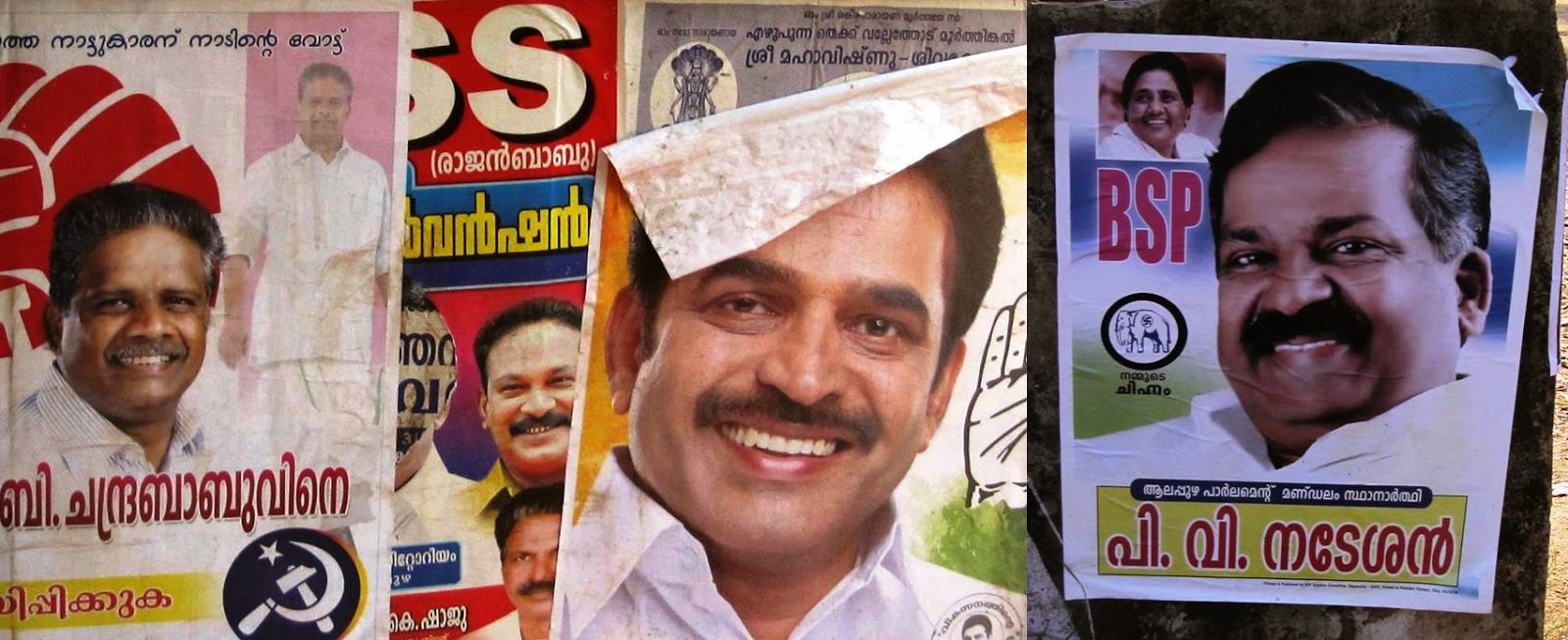
It's election time in India, and the loudspeaker vans are out daily, canvassing support with the aid of loud, raucous Bollywood anthems.
I don't know how many alphabets there are in India, let alone how many languages, to say nothing of the religions and regional loyalties, - and that's before you start to talk about caste. India is diverse by definition, and it is to their enormous credit that Indians have embraced democracy on the Westminster model and created a stable government and a thriving economy.
But while in America, at least in some ways " It all started with Columbus," various periods of foreign domination were just part of the history of India. People sometimes forget that India has a rich and lengthy cultural heritage, stretching back way before the British Raj, or even the Mogul empire. India has been around for a long time, and while it was never one nation until the Brits arrived with their cunning schemes to "divide and rule," it was a truly multi-cultural society with some highly developed aesthetics and refined scientific concepts. 
Brahmagupta established
the first rules for dealing
with zero as a number

Take Crores and Lakhs, for example. No, you can't order Chicken Crore Masala or Lakh Bhajis; the concepts have nothing to do with cuisine. These are sophisticated units of measurement that stem from a sophisticated appreciation of mathematics.

Our Western system goes up to a million, after which billions and trillions vary in size, according to whether you are European, American or Don't Know. It was one of the great jokes of modern economics that politicians around the world talked glibly about billions without defining whether they were talking American billions (a thousand million) or European billions (a million million.) There's a sizeable difference there, before you even venture into trillions. Sadly, the UK government decided to downsize to American billions in 1974 and proper British billions went the way of Avoirdupois weights and measures.

India has slightly more practical concepts, of a lakh (one hundred thousand) and a crore (ten million.) After more than sixty years of independence, India shows no sign of talking the same language when it comes to big numbers. And why should they? Mathematics in India was a gift from the Persians; democracy was a gift from the British; it would be interesting to debate which has been a more practical gift. 

Electioneering in India can be quite entertaining. 
Photos in yesterday's Times of India (Another colonial heritage, right down to the font,) showed a troupe of actors telling the anti-capitalist story with sketches promoting the Communist Party. There is plenty of music and singing when the politicians are on the road, in addition to glad-handing and baby-kissing. One nearby village had a big rally earlier this week, with hundreds of plastic chairs laid out neatly in rows. There was a scaffolding dais that was being draped with party flags while the sound engineers struggled to test the audio system even as the party faithful were arriving. 

Bunting and flags are everywhere together with hundreds of posters portraying images of the candidates. In this part of Kerala, they all bear a remarkable family likeness. They all have a broad smile with perfect white teeth; they have thick black hair and a very bushy, neatly-trimmed moustache. They all wear a ground-length dhoti, and a plain, short-sleeved, open-necked shirt. Yes, they are mostly men.
I am always amused to see the hammer and sickle stencilled on walls and printed on leaflets and flyers. In my youth, this was the symbol of oppression; of drab people from drab countries that were united under Russia in plots to destroy all the good things in life - like cricket and the BBC Home Service.
Here in India, the communists all look quite normal, and probably a bit more fun than some of the earnest career-politicians in the other parties. 

I wonder if the outcome of the elections will make much difference to the one sixth of the global population who live in India.
Looking back on the country since I first came here in 1970, it's made amazing progress. Maybe it's the imperial heritage of parliamentary democracy.

Or maybe they're just good at maths.   

Tuesday, 1 April 2014

Food, Pills and Potions

There are always some guests who want to write their own menus and exercise regimes and be issued with permits to slip off for a beer or a cigarette. They were at AYV when I was in Kerala 3 years ago, and they're here at Mattindia, too. Of course, they will all plead that they are a Special Case. I just cannot do that. I cannot disregard the programme the way they do. I just don't understand the thinking behind investing the time and money in a well-proven detox programme, then to decide that you will design your own modified version.
Take two at bedtime

Of course, there are some parts of the regime that are more challenging than others, and I saw this coming when the charming doctor approached me yesterday lunchtime with the magic words: "Tonight you have purgation." 
Purgatory

Purgation is not a word in common usage outside of Catholic doctrine, where it means the ritual cleansing of a soul in purgatory. It does however have a secondary, and just marginally less frightening meaning, which is the evacuation of the bowels brought about by taking laxatives.  You can trust India to use the correct language, especially when Britain has dismissed old vocabulary in favour of a more delicate phraseology.
Doctor explained: "Take these two pills at bedtime and keep drinking plenty of water. Tomorrow, you will have no food, only rice water." What could I say? Only one phrase seemed appropriate, given the language being used: "Forgive me Father, for I have sinned."

Two main elements of Ayurvedic treatment are the external therapies of massage, including water, oil, and steam treatments, and the internal therapies of food, potions and pills. The potions and pills are all herbal and all conform to my grandmother's evaluation of medicines, which was that if it didn't taste bad, it probably wasn't doing you any good.
Some of the pills are the size of spherical beads and almost impossible to swallow; most of the powders are not soluble, so they float suspended in water to create a gritty concoction with a taste that lingers unpleasantly. 
Medicated clarified butter

The one standard on all the Panchakarma detox programmes I have done over the past decade, has been the heavily medicated ghee (clarified butter.) This is an extremely unpleasant way to start the day, and leaves a greasiness in the mouth that only gradually diminishes with the daily breakfast starter of fresh fruit salad. However, the reality is that after less than 10 days of treatments my face looks thinner and my tee-shirts hang more loosely. I would love to tell you how much weight I have lost but . . . I really don't want to reveal this. Let me just say that the scales in the surgery were not designed for calibrating a big Englishman, and when I stood on the platform, I registered off the scale. 

I am glad I started the Daniel Fast before I left home. It did give me a head start, and it's now almost a month since I tasted meat or fish. However, I did decide that the no-alcohol rule only applied under 30,000 feet, and allowed myself a couple or three whiskies on my flights out. 

Watermelon juice
The menu here is very simple, with small portions and nothing even vaguely like a dessert. 

After the fruit at breakfast there is a small portion of a curry of chickpeas or lentils, with a couple of chappatis. Lunch will be a thin soup and a thali (tray) with a couple of curries, a small salad, a generous spoonful of rice and a poppadum. In the evening there will again be a soup, this time followed by a bowl of beans or other pulses and a couple of chappatis and perhaps a banana.
Chickpea Curry

I have never felt hungry, and once I had adjusted to regime and the ritual pummelling on the massage bench, I have been full of energy.


But today it's just rice water: broken grains of rice in tepid water with only salt for seasoning.Roll on tomorrow!

Sunday, 30 March 2014

The Agony and the occasional Ecstasy

I've been here at Mattindia about 10 days, but feel as if I've been here a month, especially as my body is now more or less adjusted to the initial effects of the harsh therapies and unfamiliar medicines. The first Seven-Day phase is completed, and the treatments are now marginally less painful.
What one might imagine an Ayurvedic treatment room to look like
 - as seen in a local 5-star hotel
Let me describe my typical morning session.
After breakfast I settle on the verandah with my laptop, to see what's been happening to the family on Facebook, or write up an action list for the Cathedral Congregation Annual Barbecue, which I inevitably volunteered to organise, or I search out some photos for this blog.
By contrast, this is my  treatment room
Mid-to-late morning Arjay the masseur seeks me out and I nip back to my room to park my laptop and to strip down to a discreet wrap-around and walk down the corridor to the massage room.
Any images of lush, decadent décor should be dispelled; this room looks more like a stock-room at the rear of a back-street garage than a specialist treatment room at a health clinic. To be fair, the painter/decorator is working his way round the building, and much of the façade is now gleaming white and the woodwork has adopted a vibrant shade of royal blue, and it's difficult to keep a place clean and tidy when you're sloshing around large quantities of massage oil.
My two cheerful masseurs
 The massage bench is natural wood with an up-stand all round and a drain hole in one corner. The tiled floor of the room is engrained with years of massage oil and the walls carry the scars of splashes and smears. The therapists wear everyday clothes that also bear the stains of their trade. . . BUT . . . they are superb at their job. They always work in pairs. If I am standing or sitting up, then one works on my front while another works on my back. If I am lying down then one works on my left and the other massages my right. They work in rhythmic harmony, which has a wonderful, relaxing effect.
However, as I wrote in my first post from Kerala, they have the ability to locate the precise, painful pressure points on the side of the thigh or the centre of the instep, and work on them until I am literally screaming for mercy. I have spent a whole week writhing in agony, pleading for respite and gasping for breath. Other guests give a knowing nod and smile, because they've all been through it in their first week.
Now in my second week, the nature of the massage has changed and is in general less conventional and more gentle.
Hot, slippery, soothing oil massage
I climb on the bench and lie face-down. At the foot of the bench is the boiling ring linked to the gas cylinder, and on the ring is a large pan of medicated oil, roughly the colour of engine-oil, but with a definite herbal aroma. The men scoop out oil and pour it into long-spouted jugs that look like small designer-watering-cans, but without the rose. 

They then start at my feet and pour the hot oil over me, working up and down and side to side. The effect is amazingly soothing, except when they pause on one spot and the heat builds up, forcing me to wriggle and squeal, trying to avoid the painful build-up of heat. After the best part of half-an-hour, I turn over - not an easy manoeuvre when you're totally laid-back, very slippery and dripping with heavy oil - and lie face-up. The process continues, and is almost hypnotic, though when they work around my lower waist, the sensation of a flow of warm oil, to and fro across my genitals, is unusual, - to say the least. The whole process lasts about 45 minutes, after which I sit on a chair to recoverwhile the masseurs clean up and boil the oil so it's sterilised and ready to use on the next patient.
Muslin bags of herbs tied into powerful scented pommels.
The nonsensical candle shows they have Art Directors in India, too.
They then prepare the pommels of herbs which are used in the next treatment.
These are squares of muslin that are tied tightly around a stuffing of herbs to form a pommel. They are put into a shallow dish of a different oil over the flame to heat, releasing a strong herbal fragrance. I then climb back up and lie down, to be pounded all over with these bundles of oil-warmed herbs. It is an exhilarating sensation, but very tiring, and by the end of the session I am dripping with a mix of sweat and massage oil. I stagger back to my room with strict instructions to sit quietly for half an hour, until my body temperature has normalised, then I can take a shower and think about lunch.
After little more than a week, I can feel a difference, and from the comments of fellow-guests, it is visible. It all seems to be working well.

Wednesday, 26 March 2014

A Pilgrimage Party

Canterbury Tales by Geoffrey Chaucer
Walking the Camino
de Santiago in Spain
Muslim pilgrims in
Mecca for their Haj.
A pilgrimage is generally considered to be an act of contrition, penitence, whether it is the Haj or the 800km Camino de Santiago across Northern Spain.

Life was a little livelier when Geoffrey Chaucer wrote Canterbury Tales, and if yesterday was anything to go by, a pilgrimage in India can be a wonderful excuse for a party!
I had no idea what to expect from the note pinned up on the wall of the dining verandah. We were asked to be ready to leave at 06.30; all treatments were cancelled for the day and our accounts would be credited accordingly.
Of course, this is India, so 06.30 meant that we'd be lucky if we got away by seven and nobody won my sweepstake since nobody bet later than 07.25, and it well after half-past when the bus pulled away. Before we boarded, all the staff gathered in front one of the shrines in the entrance hall and recited a prayer. It seemed that they were all taking the pilgrimage seriously.
It was a couple of hours' journey to reach our destination, and no sooner had the bus ground to a halt than all the staff were scurrying around arranging breakfast. It was efficiently organised and within minutes everyone was devouring vegetable curry eaten in the fingers with chapatis and rice-flour pancakes. The group then clustered in front of one of the monumental statues and led by Joy, the proprietor of MattIndia, sang a hymn and chanted a prayer. We then all set off through the forest, climbing towards the various Stations of the Cross that marked progress.
My legs were aching from the vigorous massages of the past 4 days, and I realised I would not be able to climb the mile or so up the steep hill.I decided that the purpose of the walk was to find some spiritual solace, and I found a rock to sit on and enjoy the beautiful surroundings.
80 litres bottled water =
almost 100kg per load

As I sat there, I watched the porters follow the track, each carrying two cartons on his head, loosely roped together or tied with a cloth.
Each load was made up of 80 litres of bottled water, grossing approximately 100 kg. The journey to the top of the hill would take about an hour, and they were paid on a piece rate of 100 rupees per trip, and would make 8-10 trips per day.
Since the exchange rate is 100 rupees the the pound, they made good money by Indian standards - but they most certainly earned it!
I relished the luxury of my solitude until my fellow-guests started to come back down the mountain and, after everyone had consumed large quantities of water, we piled back into the bus for the forest by the river and waterfalls, where we would have lunch.
Thomas is generally portrayed
as a young man
Thomas was one of the original 12 disciples and is remembered for challenging the others when they claimed they had seen Jesus after the resurrection. When he did later meet Jesus in the Upper Room where they had dined together at the Last Supper, Thomas was ashamed by his earlier behaviour and became one of the most dynamic, evangelising apostles. As a Roman Jew, he could travel easily to the overseas Jewish merchant communities and sailed to South India to meet with the Jewish community and preach Christianity.
"Footprint" in the rock


He landed in India in 52AD and a shoe-shaped hollow in  a rock is revered as his footprint. He went on to establish seven thriving Christian communities in Kerala baptising thousands personally and training his own disciples who continued his work throughout central Asia.
When we later stopped to visit one of the churches, there were broad steps at the side of the churchyard, leading down to the Periyar river. Here, priests continue to hold baptism ceremonies, just as Thomas did almost two thousand years ago. It gradually dawned on me that there were Christians in Kerala many centuries before there were Christians in Lincolnshire.
After we drove away from the shrines, churches and stations of the cross, and left behind the chanted prayers and communal hymn-singing, the driver put Bollywood music on the coach's audio system at deafening volume. Within seconds, a dozen people were dancing in the aisle of the bus. As dusk descended, he flicked a switch and on came the disco strobe lighting. Everyone (well, almost everyone,) joined in clapping and singing, and the dancers were thrown from side-to-side as the coach bounced along the road.
The atmosphere was definitely Chaucerian, and everyone - having done their penance and their pilgrimage, settled into a rave.
Preparing vegetables for dinner
By the time we reached Kochi, people were getting hungry, but everything was already planned for one final picnic. 
We pulled into the front drive area of the home of someone's relative, and quickly set about preparing vegetables and putting pots of water on gas burners.

The festive mood continued through dinner and all the way home; everyone worn out and glad that the next morning's 7am yoga had been cancelled.

Sunday, 23 March 2014

What is your good name, kind sir?


In 1959 I was still Bobby
My grandmother called me Robin, my father called me Jumbo, my mother called me Bobby, my primary-school teachers mostly called me Robert, and in secondary school I was Harvey to both masters and my peer group.
Bob as a VSO youth-worker in Nairobi

As a volunteer in Kenya I was Bob, though I cannot believe I ever coached boxing! 
I think that was just for the benefit of the photographer from the Daily Nation or the East African Standard. 
Was I ever that slim?
I was slowly finding my identity and by the time I went to Sussex University, I was outwardly extrovert and inwardly very confused. Nothing unusual about that, I'm sure, because when you're a few inches taller than 99% of people you are bound to feel different and struggle to find your own identity. 
After graduation I started work for Bata in Aden (Yemen) and mingled with the Colonial Service crowd, (Yes, Aden was a British colony) Historical note: in 1967 I went to the last night of the Club, which was the last existing British colonial club in the world, others still existed but had relaxed their membership rules. In Aden, the membership rules insisted that all four grandparents had to be born British. Aden knew it was the end of an era and bid farewell with a few hard-drinkers and a couple of choruses of "Rule Britannia." 
My friends in Aden adopted my early childhood name of Jumbo, then in my next post I was Robert J. Harvey BA, MInstM. 
In my restaurant, with my Italian nephew, Aldo 
So I was then Corporate Man for about ten years, but I went through a series of consecutive executive failures, until I finally realised that my face just didn't fit in the corporate world. So I went back to my love of food, wine and cookery and for 15 years I ran a restaurant. My staff christened me "Mister H," because they were not comfortable on first-name terms. Even those who later became good friends found it impossible to call me anything else - to this day.
21st century
corporate Bob Harvey
After the restaurant closed I took a new route when I discovered that there was a dearth of corporate writers. For me, writing was really "money for old rope," and in three months my turnover was greater than if had been in any 12-month period of the restaurant.
And so I am, and have been, a writer ever since. Sometimes blogging, sometimes writing for magazines, writing copy for business brochures and editing books for children. I also write speeches for executives, and then train them in public speaking.
All very corporate and very boring, so when I hit the ripe old age of 70, last month, I decided it was time to rebrand once again. 
My son in America, Tobias John Harvey, had been known as "T J" from childhood, and the name "R J" appealed to me as a complete break from the past and an opportunity for yet another new beginning. 
I rebranded myself Arjay
I am not going to go through with deed poll and make it all official, and I will still be Dad, Grandpa, Pops, Poppa and various other names - including "Bob" to those who know me as such. However, with a certain circle of close friends I am becoming Arjay, and I like the sense of a new identity.
Coming to Kerala has been the first time in a long time that I have been asked for my name.
It was the masseur who asked, as he started to coat my chest with a liberal quantity of coconut oil. 
"What is your good name, kind sir?" was the quaint phrase, and he stopped and stared when I replied "Arjay."
"But that is my name, Sir, I am Arjay! Why are you having an Indian name?"  Which was a pretty fair question, but looking at the affinity I feel for the sub-continent, was really a question that answered itself.